The Trump Administration Deported a Military Deserter Back to Russia. Then He Escaped Again.
In interviews with The Moscow Times, Artyom Vovchenko recounted his improbable and highly risky flight from Russia earlier this year.
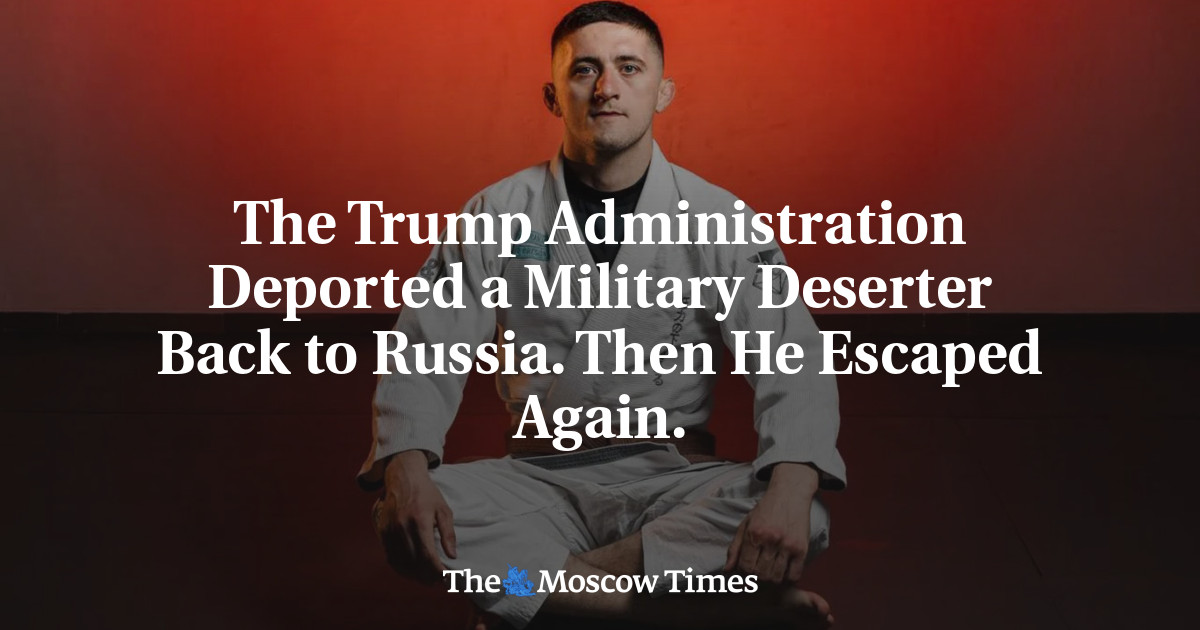
Crossing the border into Belarus, with Russia in the rearview mirror behind him, Artyom Vovchenko breathed a sigh of relief. He knew, in all likelihood, he would finally be free. It had been a long journey. After deserting from the Russian military in 2022, Vovchenko, now 27, stepped into a life of uncertainty, attempting and failing to secure political asylum in the U.S. Last summer, he was deported back to Russia , where he faced imprisonment or being sent to fight in Ukraine. The U.S. has deported scores of Russians back home as part of a widening immigration crackdown under the second Trump administration, but few are known to have replicated what Vovchenko did next: he escaped for a second time. “In the SVO, those with a charge like mine, they’re sent into assaults , 70% survive,” Vovchenko said, using the abbreviation for the Kremlin’s term for the war. “I knew I had to do something.” Vovchenko recently gave two interviews to The Moscow Times recounting his improbable and highly risky flight from Russia earlier this year. This story is based on his recollections, as well as documentation that he shared about certain aspects of his experience. Some parts of his account were not able to be verified. For a deserter, being on the run is dangerous. Russia mandates strict punishment for the act, which carries a prison sentence of up to 10 years, and has been known to aggressively lobby for deserters in other countries to be extradited so they can stand trial. Vovchenko’s exploit sheds light on the depths of some would-be combatants’ desperation to escape the war machine at a time when countries are showing increased willingness to send them back to Russia. Citing continued threats to his security, Vovchenko declined to share his current location with The Moscow Times, saying only that he is in a country where he is trying to start a new life and looking forward to better times. In the system It was the prospect of finding a permanent place of safety that brought Vovchenko from Indonesia, where he’d been living and working as a mixed martial arts coach, to the U.S. in the summer of 2024, about two years after he deserted from the Russian military. Like any other asylum seeker, he was integrated into the sprawling U.S. immigration apparatus. In recent years, this has increasingly meant spending time in detention centers. Over the course of the next 13 months, he rotated through different detention centers while his asylum application case worked its way through the courts. Artyom Vovchenko. Courtesy photo All of this was a far cry from what he was used to. Originally from the city of Zelenokumsk in southern Russia’s Stavropol region, Vovchenko only joined the military because he had to. He studied law at a university in the city of Saratov, attended rallies in support of the late opposition figure Alexei Navalny, maintained an affinity for beekeeping and practiced jiu-jitsu. “I didn’t really understand politics, I just understood that something was wrong and we were going in the wrong direction,” he said of his formative years in school, when he started to become politically conscious. Every able-bodied Russian man must complete compulsory military service, and Vovchenko began his in 2020. In 2022, after an episode in which he claimed his service was prolonged without his knowledge, he deserted during the early days of the full-scale invasion. Now, after a brief period of freedom, he was essentially a prisoner . Vovchenko said although the conditions of his detention in the U.S. were “bad,” he was still treated “humanely.” He spent some of his time working in the kitchen and trying to learn English with the help of a grammar book ordered for him by a friend. One day, while lifting a large container of liquid, he suddenly felt pain in his back. According to a medical report from a Moscow clinic dated Oct. 13, 2025, and shared with The Moscow Times, Vovchenko had suffered a herniated disc, when soft tissue pushes out between the bones of the spine. It’s an injury he’s still struggling to recover from today — a reminder of his time in detention and the past he’s trying to put behind him. Vovchenko was in detention when Donald Trump was elected president on a platform that promised to ramp up deportations of undocumented immigrants. Rights advocates had already been noticing a hardening of the immigration system under President Joe Biden , with Russians being sent to detention centers with greater frequency. There, they faced prolonged detention and the possibility of being deported back to Russia. This was a dangerous proposition. Many Russians seeking asylum face persecution from the Kremlin for past activism or political work. Being deported back to Russia could represent an immense threat to their human rights, activists say. An in-depth story written about Vovchenko’s case by The New York Times last fall shed light on aspects of his imprisonment and deportation. Among them, it was reported that Vovchenko tri