As Their Nationwide Pollution Problem Deepens, Russians Say They Have Bigger Worries
New data shows that nearly 60% of Russians are exposed to pollution. For many, economic pressures leave little room to worry about the environment.
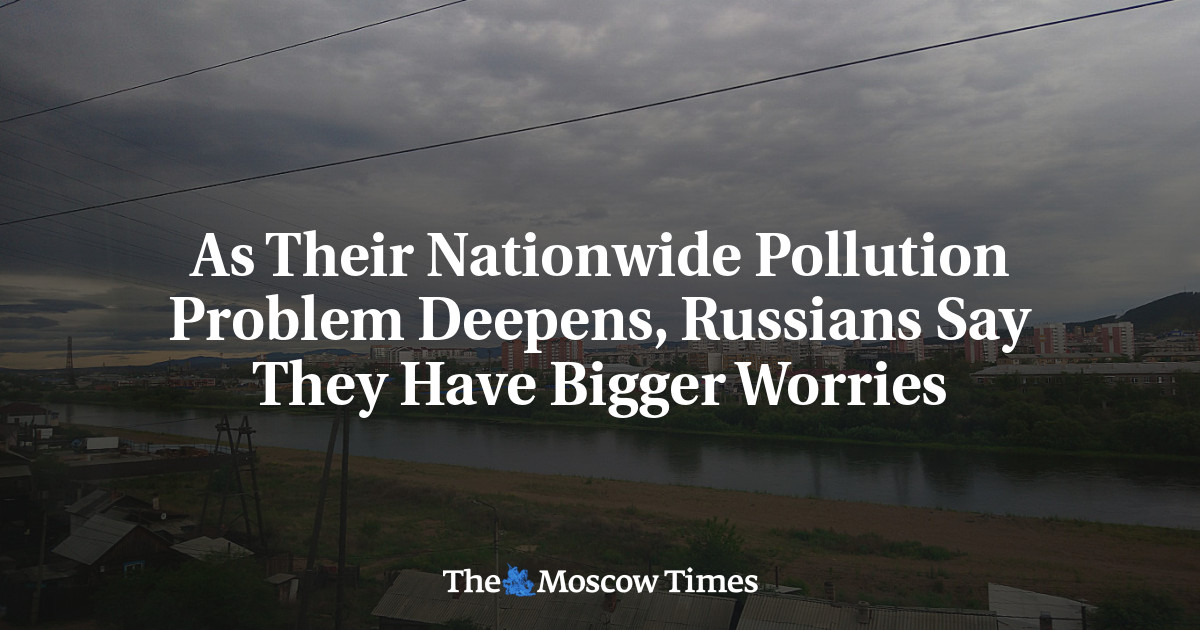
For residents of Ulan-Ude, the capital of Russia’s republic of Buryatia, the fleeting Siberian summer offers a rare chance to breathe clean air. Situated on a low plain surrounded by mountains, Ulan-Ude is plagued for most of the year by smog from coal-fired power stations and the stoves used to heat its many single-family homes. “Problems with air pollution have existed here for a long time,” a woman from Ulan-Ude told The Moscow Times on condition of anonymity. “Things are fine in spring and summer, but in winter, it is impossible to breathe at times.” Siberia’s cities and towns consistently rank as having some of the worst air pollution in Russia, a result of their heavy reliance on coal, emissions from heavy industry and increasingly severe wildfire seasons. What once seemed like a regional anomaly in the biggest country on Earth has now become an everyday reality for roughly 57% of Russia’s population, according to a report published this month by consumer safety watchdog Rospotrebnadzor. But as Russians contend with more urgent problems like fuel shortages and rising grocery prices , environmental concerns — and their impact on public health — have slipped down the list of priorities for some. “Surprisingly, the topic of air or water quality hasn't come up in recent years, although we used to talk about it a lot back in the day,” said one native of Chelyabinsk, a major industrial hub in the Ural Mountains notorious for its pollution. Thousands of kilometers to the east in the Siberian highlands, people describe a similar outlook. “The air in winter is terrible here. Soot from the coal is everywhere,” a man from the republic of Tyva said. “A friend once came to visit me and was shocked when he blew black snot out of his nose, but we have gotten used to things like that. If our snot is that black, can you imagine the state of our lungs?” Rospotrebnadzor’s data suggests that 83.6 million Russians were exposed to aggregate chemical pollution in water, air and soil in 2025, compared to 79.1 million in 2024 and 75.4 million in 2023. The increase reverses years of declining pollution exposure that followed the 2016 launch of Russia’s flagship Clean Air Federal Project, which aimed to reduce emissions in dozens of industrial cities. In the first six years of the program’s existence, the number of people exposed to aggregate chemical pollution fell from 92.8 million in 2016 to 74.2 million in 2022 before beginning to steadily rise again. This reversal, in turn, coincided with the government’s 2023 decision to cut funding for several flagship state environmental programs, with Clean Air’s funding nearly halved for 2024, with cuts of 6 billion rubles ($62 million). A Russian environmental analyst told The Moscow Times that Western sanctions, the reorientation of exports toward Asia and the economy’s placement on a war footing since the full-scale invasion of Ukraine are the key factors behind the increasing environmental pollution. “The country where authorities launched the Clean Air project in 2016 no longer exists. Up until 2021, it was one country. From 2022 onward, it is another,” said the analyst, who spoke anonymously for safety reasons. The Uda River in Ulan-Ude. Alava (CC BY-SA 3.0) Norilsk Nickel Nadezhda Plant. Ninaras (CC BY 4.0) The same goes for businesses and corporations, which before the war had sought to implement more environmentally sustainable business practices, following the lead of Western investors and markets that often demand sustainability compliance as a prerequisite for entry. The departure of many foreign investors and business partners after the start of the full-scale war in Ukraine in 2022 quickly put an end to this trend, the expert said. "They are no longer oriented toward Western markets. They are oriented towards the Russian [military-industrial] complex," they said. "No one asks Russian companies for their ESG ratings anymore, or whether they even have such reporting. Chinese companies or other new buyers don’t care about that stuff.” Meanwhile, Europe’s embargo on Russian coal has also helped put the country’s energy transition on ice. With exports falling sharply while production remains relatively high, the coal-reliant regions of Siberia and the Far East have become an increasingly important domestic market for Russia’s collapsing coal sector, an industry that feeds hundreds of thousands of people. This has prompted business owners and governors to team up in attempts to defend their regions against renewable energy sources, the environmental expert said. “We have open-pit coal mining here, so there is a lot of soot in the winter. That's probably why so many people here have lung problems,” said a person who lives in a coal-mining district in the Siberian republic of Khakassia. “Our houses here often shake due to explosions at mining facilities. When you wash your car, a lot of black dust accumulates after about four hours, even if the car was parked the entire time — i