Trump Rejects New Russia Sanctions at NATO Summit Filled With Big Spending and Big Emotions
Despite Trump’s aggressive posturing at the summit’s opening, he later hit a more promising note with Zelensky.
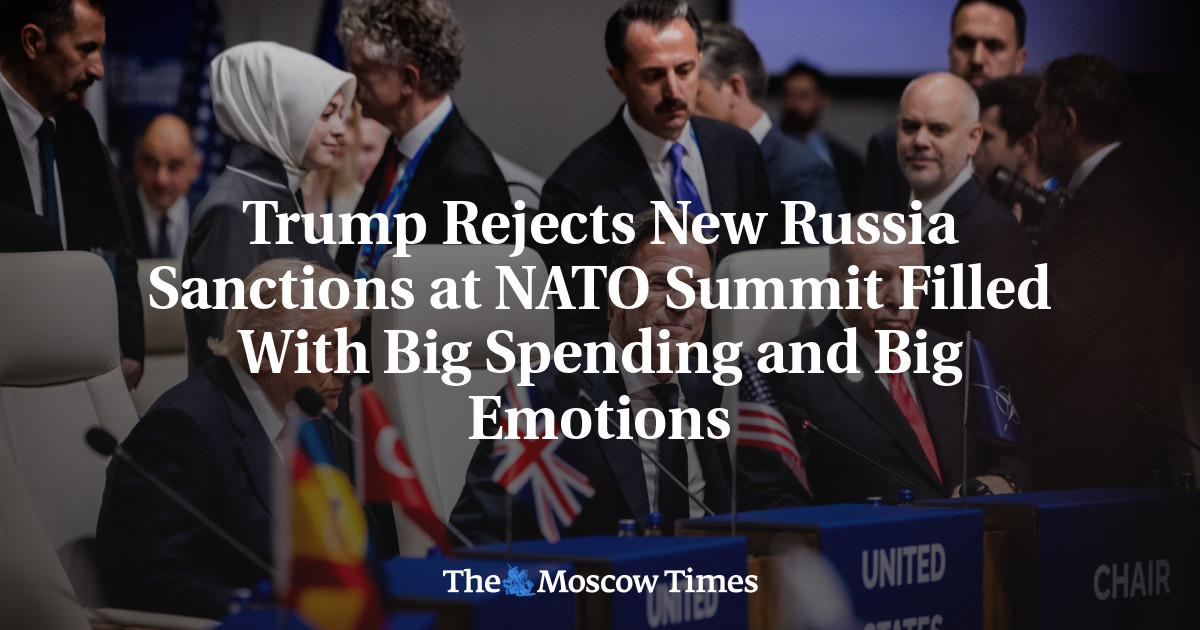
ANKARA – NATO’s annual leaders’ meetings have become exercises in pleasing U.S. President Donald Trump, or at least to buy time for the alliance’s European members and Canada to prepare for a world in which Washington is no longer the cornerstone of their security. Watching the final press conferences at this year’s summit in the Turkish capital, one would think it was mission accomplished — and then some. The alliance reaffirmed its commitment to the Article 5 collective defense mechanism, amid fears that the U.S. may not intervene to defend members against a Russian attack. Following the meeting, Secretary General Mark Rutte and Trump both gushed to the press about the unity shown at the meeting of 32 assembled leaders. And in a speech straight out of a campaign rally, the U.S. president rambled about how much love the rest of NATO showed him and his country, boasted of being No. 1 on TikTok and warned about the dangers of Communism, joking that he’d be a better Communist than Bolshevik leader Vladimir Lenin. Rutte was appointed Secretary General in large part due to his reputation as a Trump whisperer. Thus, the summit agenda seemed set up to speak the language Trump knows best — money — to show that the alliance was taking seriously Washington’s demands that they not rely on American military might for all of their defense. Trump didn’t make it easy for him. The U.S. president reiterated his demand that Denmark allow Washington to take over Greenland, saying he was “not happy” with NATO for backing Denmark’s refusal to hand it over. He took aim at member states for not doing enough to support Washington’s war against Iran and ordered an end to trade with Spain over Madrid’s low defense spending. Upon arrival in Ankara, Trump said he only came to the summit because it was being hosted by Turkish President Recep Tayyip Erdoğan, with whom he shares a similar strongman worldview. The price of trying to convince the U.S. president: billions of dollars in new equipment. The keynote announcements at the summit’s Defense Industrial Forum included a plan to purchase up to five Triton reconnaissance drones, two transport and tanker aircraft, and up as many as 10 GlobalEye early warning and control aircraft which a promotional video claimed could detect enemy aircraft and incoming missiles from as far as 650 kilometers (400 miles) away. A NATO official later put the cost of these acquisitions at $50 billion, but not all prices have been set. Micael Johansson, CEO of the Swedish Saab engineering firm behind the GlobalEye, later told reporters that no contract for ordering the systems had even been signed yet. On top of that comes a commitment to spend $40 billion on counter-drone defenses, $26 billion in missile defense and $1.6 billion in new strike capabilities. Members also announced new mechanisms to make defense spending more efficient. Notably, while U.S. defense heavyweights like Lockheed Martin and Palantir landed new deals, many of the headline acquisitions came from European companies like Saab and Germany’s Rheinmetall. While arms deals are important for maintaining ties with Washington, which produces some equipment that other countries cannot currently match, the deals at this summit reflect concern among non-U.S. members about the need for strategic autonomy from Washington, an ally that has placed restrictions on what countries can do with weapons it manufactured to avoid escalation with Russia. I got straight into things at NATO in Ankara by asking Secretary General Mark Rutte for @MoscowTimes about Finland and Lithuania's recent votes to lift their prohibitions on hosting nuclear weapons on their territories. pic.twitter.com/QXb4z7tiFD — Charlie Hancock (@Hancock2001) July 6, 2026 Ukraine’s accession to NATO is not a realistic prospect in the immediate future, with multiple member states opposing it at least while it continues to fight off Russia’s invasion. But Zelensky renewed his calls for his country to be allowed to join, arguing it was a natural member because of the technical and tactical innovations it has made since 2022. On the first day of the summit, Ukraine signed new deals with Estonia, the Netherlands and Denmark to share its cutting edge expertise in drone warfare in return for royalties, military hardware and investments. But Zelensky also used the summit to appeal for more air defense deliveries, especially Patriot missiles that are essential for intercepting hypersonic ballistic missiles. Ukraine failed to intercept any ballistic missiles in a deadly overnight Russian attack on Monday, on the eve of the two-day summit. Alongside the big-ticket purchases, NATO committed to deliver $70 billion in aid to Ukraine by the end of 2026, and to match or exceed that amount the following year. Kyiv has looked to Europe to source air defense weaponry that is less reliant on American manufacturing timetables and weapons stocks being purposed for conflicts in the Middle East. In late May, Ukra