The prosecution and the pardon that ended the diesel wars
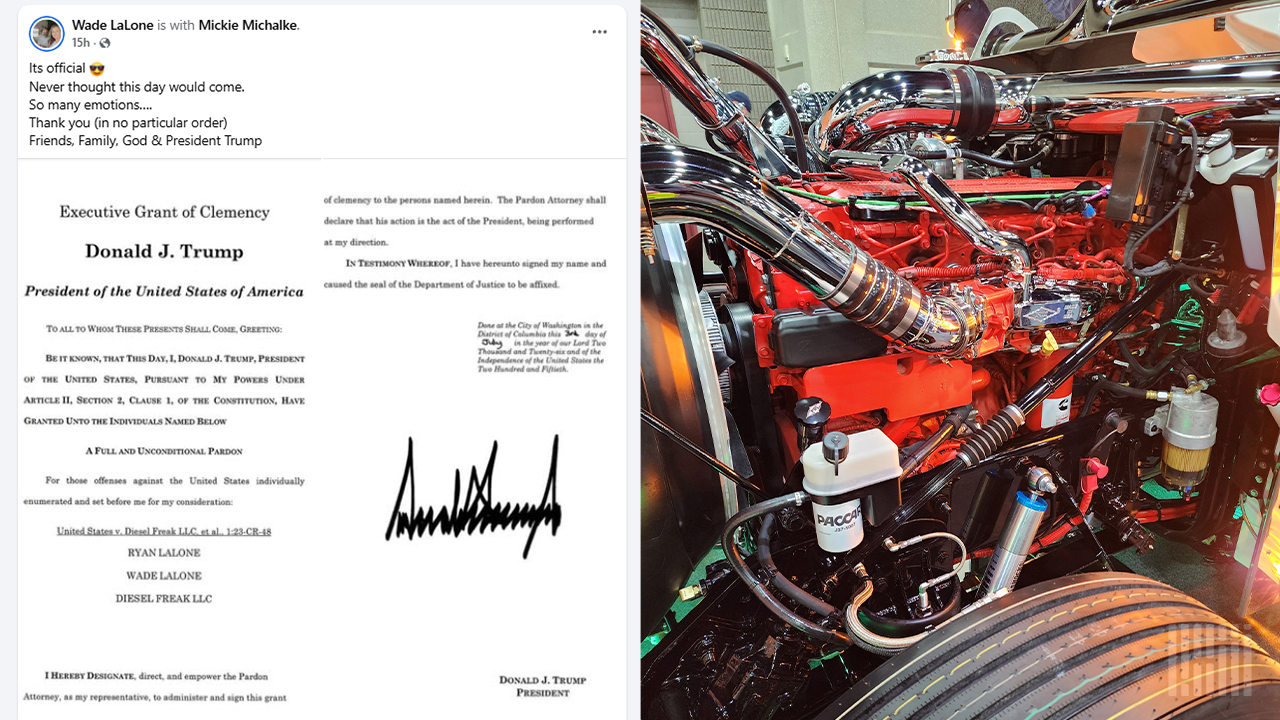
On Thursday night, Wade LaLone posted a photograph to Facebook showing off his two-page pardon, AKA, “Executive Grant of Clemency,” signed in the iconic Trump thick black Sharpie strokes and dated the third day of July in the year of our Lord Two Thousand and Twenty-six. Wade’s caption: “It’s official. Never thought this day would come. So many emotions.” Several received a full and unconditional pardon in United States v. Diesel Freak LLC, et al., case number 1:23-CR-48, in the Western District of Michigan. Three names appear on it: Ryan LaLone, Wade LaLone, and Diesel Freak LLC, the Gaylord, Michigan, performance shop the brothers built. In 2023, federal prosecutors charged the LaLones and nine other individuals in one of the largest criminal diesel tampering cases ever brought, a sweep that also pulled in Accurate Truck Service and a web of associated fleets. The brothers each received a one-year probation. Their business took a felony. They were not alone on the pardon list. Trump announced Friday on Truth Social that he had signed pardons for people who were, in his words, persecuted by the Biden Administration and sent to prison for fixing their car. A White House official later confirmed 11 names in total: the LaLone brothers, Matt Geouge, Tim Clancy, Mackenzie Spurlock, Joshua Davis, Barry Pierce, Aaron Rudolf, Adam Kidan, Jack Harvard, and Jonathan Achtemeier. According to a Fox News review of federal court records, at least eight of them were diesel mechanics or tuners prosecuted for selling or installing devices that bypass federally required emissions controls. Geouge’s case shows the scale of the market the government was trying to kill. According to his December 2021 plea agreement, the two companies he ran grossed more than $10 million from the sale of illegal tuning devices alone. The “system” the EPA built To understand why grown men went to federal prison over exhaust pipes, you have to understand what is hanging off the back of every diesel truck built since 2007, and why drivers hate it. Modern diesel emissions control is a stack of four interlocking systems. Exhaust gas recirculation, or EGR, routes a portion of exhaust back into the intake to lower combustion temperatures and cut nitrogen oxide formation. The diesel particulate filter, or DPF, is a ceramic honeycomb in the exhaust stream that traps soot, then periodically burns it off in a process called regeneration, which dumps extra fuel into the exhaust to hit temperatures around 1,100 degrees. Selective catalytic reduction, or SCR, injects diesel exhaust fluid, the urea and water mix every trucker knows as DEF, into the exhaust to convert nitrogen oxides into nitrogen and water. Watching over all of it is the onboard diagnostic system, the OBD, a network of sensors that monitors every component and reports faults. The OBD isn’t just about diagnostics; it enforces compliance. Run out of DEF, or throw a sensor code the system reads as tampering or malfunction, and the engine control module begins derating the truck. First, it cuts power. Then, under the inducement strategies EPA required manufacturers to build in, it can limit the vehicle to as little as 5 mph. The industry calls it limp mode. A loaded truck limping at 5 mph on an interstate shoulder is a stranded asset, a missed delivery, and, for an owner-operator, sometimes the difference between making a truck payment and missing one. The failure rate of these systems is extreme. Brad Bylsma, the state equipment fleet manager for the Alaska Department of Transportation , said in March that DEF systems account for a significant portion of the maintenance issues and costs across state-owned diesel vehicles. My personal 2023 RAM Cummins delete kit went from $1800 or less for 2022 and older models to $7,000 for 2023 and newer models. At 68,000 miles, the Cummins engine, which would probably outlive me, could no longer operate due to a DPF failure that required a complete emissions system replacement. That was at only 68,000 miles! The truck was over $65,000 new. DEF freezes at 12 degrees Fahrenheit. Sensors foul. DPFs clog on trucks that do a lot of low-speed, low-temperature work, which describes school buses, ambulances, plow trucks, and farm equipment, the exact vehicles that kept showing up in these criminal cases. Sen. Dan Sullivan of Alaska defended one of the pardoned men by noting that his shop modified emissions systems so that trucks would not shut down in subzero conditions. The delete economy When a compliance system strands trucks over sensor faults, a market emerges to circumvent it. That market industrialized years ago, and it splits into a few distinct products that get lumped together in coverage but should not be. A full delete is the removal of the hardware, the DPF, the EGR cooler and valve, and the SCR system, replaced with a straight pipe and block-off plates. The hardware is only half the job, because the OBD will detect the missing components and derate the t